
Key Takeaways
- Probiotic potency labels can be confusing due to different measurement methods like CFU and AFU.
- CFUs measure live, viable bacteria but can be misleading since they don't always reflect survival in the gut.
- AFUs provide a more precise count of viable cells using flow cytometry, identifying cells that don't form colonies.
- Consumers should look beyond CFU counts and consider factors like strain, clinical studies, and product quality.
- Understanding the difference between AFU vs CFU helps consumers make informed decisions about probiotics.
Estimated reading time: 7 minutes
Why Probiotic Potency Labels Can Be Confusing
When it comes to reading probiotic labels, consumers have been trained to look at one number: CFU count. Some products boast millions (even billions!) of CFUs per serving. However, not all probiotic counts are measured the same way, which makes evaluating probiotic potency slightly more complex. Let’s dive into the different ways to measure probiotic potency: CFU vs AFU.
What are CFUs?
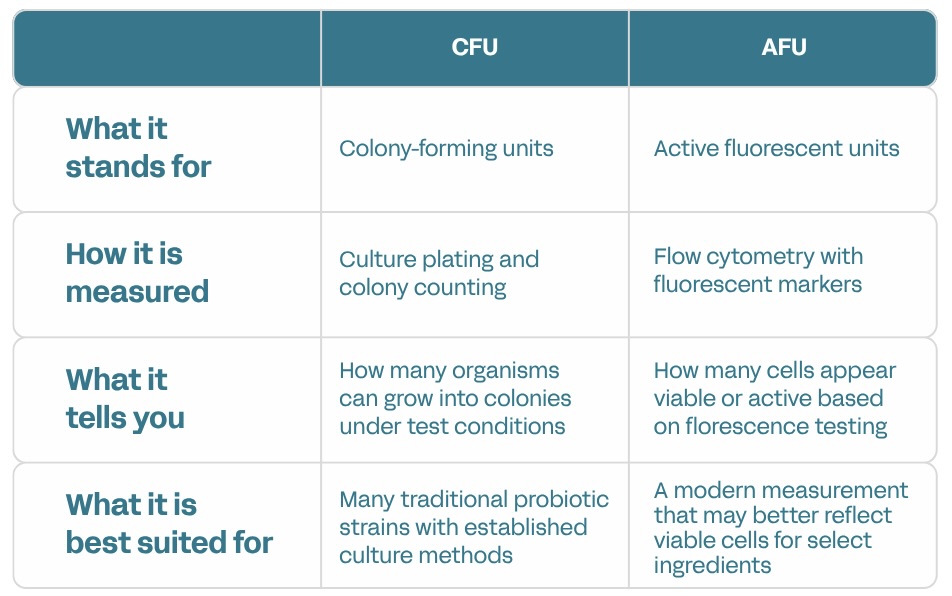
Colony-Forming Units (CFUs) measure the number of live, viable bacteria that are able to reproduce. CFU is the standard unit microbiologists use to count microorganisms.¹ This is done by diluting a sample, spreading it onto a growth medium, and seeing how many viable cell clusters are formed post-incubation. In the biotics industry, this is the industry standard for measuring probiotic viability.
However, quantifying CFUs can be limiting. Not all living bacteria can grow under standard laboratory conditions. Some bacteria enter a state known as “viable but nonculturable” (VBNC), meaning they remain alive and may retain metabolic activity but cannot form colonies under the conditions used for testing. Because CFU measurements only count bacteria capable of forming colonies, they may underestimate the total number of viable cells present.
On the flip side, the number of colonies formed in a controlled laboratory environment does not necessarily reflect how many bacteria will survive digestion and reach the gut. The human digestive tract exposes bacteria to challenges such as stomach acid, digestive enzymes, and bile salts, which differ significantly from laboratory growth conditions. Importantly, this limitation applies to both CFU and AFU measurements. While these methods assess bacterial viability differently, neither directly measures how many bacteria will survive the digestive process and reach the gut alive. As a result, the number of viable bacteria that actually reach the gut may be lower than the CFU or AFU count listed on a product's packaging. This is an important distinction for consumers: viability at the time of testing does not necessarily equate to viability after digestion.

Is CFU testing going away? We don’t think so. CFU counting has brought standardization to the microbiology industry, and it’s been used for more than 140 years.² That said, there are other ways to measure the viability and/or quality of probiotics, and we believe these methods, in tandem with CFU counting, will shape the future of probiotics.
What are AFUs?
Active Fluorescent Units (AFU) are discovered through flow cytometry tests, which is a more precise, high-tech process for counting viable microorganisms. Detectors count cells with fluorescent viability stains (often called "markers") which then reveal how many microbes are viable and intact. There are multiple benefits to using flow cytometry for probiotic counts, including A) the ability to count viable cells that are not forming colonies, and B) no incubation time is needed to quantify AFU, making it faster and more efficient.
AFU can provide a more precise, direct picture of the active cells for certain probiotic ingredients. It is not replacing CFU, rather improving the accuracy and adding to the advancing field of probiotic research.
CFU vs AFU: What are the Key Differences?
What does this mean for consumers?
Next time you find yourself browsing probiotic supplements, challenge yourself to look beyond CFU counts. The effectiveness of a probiotic depends on several factors, including the specific strain, the scientific evidence supporting it, the dose, and whether the product can deliver that dose throughout its shelf life, not just the CFU count stamped on the front.
Need help? Here is our step by step guide on choosing a probiotic supplement.
- "What am I hoping this probiotic will actually do?” This is the question to ask yourself before you even begin searching for a probiotic. Different strains have been studied for different health outcomes, ranging from standard GI distress to mental clarity and stress reduction. To set yourself up for success, start with the end goal, and work backwards through research to identify a strain (or a few strains) that have been studied for your desired outcome.
- Identify the full strain name, not just the species. This is where things take a slightly more scientific turn, but stay with us. Probiotics are identified at three levels. Let’s use our GABA-producing probiotic, LP815, Lacticaseibacillus plantarum 815, as an example. Let's break it down:
- Genus. The genus is “Lactiplantibacillus”
- Species. The species is “plantarum”
- Strain. The strain is “815”
Why is this important to know? Two strains can belong to the same species but have different biological properties. Think of a probiotic's name like an address. The genus gets you to the neighborhood, the species gets you to the street, and the strain gets you to the exact house. And when it comes to probiotics, the exact house matters, because the science supporting one strain doesn't necessarily apply to its neighbors.
- Check whether the strain has been clinically studied. Once you’ve identified the strain, it’s easier to find out if it’s been studied for the benefits you’re seeking. When researching a strain, ask yourself the following questions:
- Was the exact strain studied? Research on a related strain is not necessarily evidence for the one in the bottle.
- Was it studied in humans? Although science has advanced to a point where laboratory modeling can tell us a lot about a strain, it still doesn’t tell us how it works in the human body. Finding a clinical trial done with humans, preferably a double-blind, randomized, placebo-controlled study, is an excellent way to assess a strains’ efficacy in humans.
- Did the study measure the benefit you care about? A study showing changes in gut bacteria does not necessarily demonstrate improved digestion. Be sure to look at the outcomes of the study to understand the potential benefit profile.
- Evaluate the dose. Compare the product's daily dose with the dose used in the supporting clinical research. If the dosage is below the clinically-recommended amount, you may not receive the benefits mentioned in the study.
- Review the expiration date, storage instructions, and the manufacturer information. This step is optional, but still highly recommended. Since probiotics are living microorganisms, their viability can decline over time. This makes understanding the CFU count listed on a bottle slightly more complicated depending on if the probiotic claims CFU count “at manufacture” or CFU count “through expiration.” When it comes to storage conditions, make sure you follow the manufacturer’s instructions. Some strains need refrigeration, some don’t. Lastly, look for a manufacturer that provides accessible scientific references, transparent ingredient information, clear directions, and a way to contact the company.
Why Does Verb Biotics Use AFU for Some Probiotic Ingredients?
At Verb Biotics, we recognize that measuring probiotic viability is not a one-size-fits-all approach. Different microorganisms have unique biological characteristics that influence which testing methods are most appropriate.
For example, certain bacteria can be difficult to culture under traditional laboratory conditions, meaning viable cells may not always form colonies during CFU testing.
This is particularly relevant for LX03™, Christensenella minuta, a strict anaerobe that requires an oxygen-free environment to grow. Exposure to oxygen or unsuitable culture conditions can compromise cell viability or prevent colony formation, potentially leading to an incomplete picture of viable cell counts.
For LX03™, Verb Biotics uses AFU measurement through flow cytometry3 to assess cell viability without relying on colony formation, providing a method better suited to the strain's unique characteristics.
Conclusion
When evaluating probiotics, the measurement method matters. CFU remains a familiar and useful standard for many products, while AFU offers a modern way to assess active or viable cells for certain ingredients. For consumers, the goal is not to chase the biggest number, rather it’s to understand what the number represents, how it was measured, and whether the product is built on thoughtful ingredient selection and transparent science.
Sources
- Colony-Forming Unit (CFU). REVIVE. (n.d.). https://revive.gardp.org/resource/colony-forming-unit-cfu/?cf=encyclopaedia
- Introduction to microbiological colony counting. KEYENCE. (n.d.). https://www.keyence.com/products/microscope/colony-counter/resources/colony-counter-resources/introduction-to-microbiological-colony-counting.jsp
- McKinnon, Katherine M. “Flow Cytometry: An Overview.” Current protocols in immunology vol. 120 5.1.1-5.1.11. 21 Feb. 2018, doi:10.1002/cpim.40