
In this interview with Noah Zimmerman, Verb Biotics CSO, we discuss his learnings from the published sleep human clinical supporting the use of GABA Probiotic, LP815, for improvements in sleep quality, deep sleep, and time to sleep. Read the sleep clinical results here > LINK.
Estimated reading time: 7 minutes
Key Takeaways
- LP815 is a GABA-producing probiotic that boosts GABA levels in humans and improves sleep quality, particularly for women.
- The study focused on assessing the impact of LP815 on sleep, using questionnaires and biometric data from participants.
- Significant findings include increased deep sleep, which is crucial for memory consolidation and immune health.
- All women who took the probiotic in the trial reported better sleep, highlighting the relationship between GABA and women’s health issues.
- LP815 can serve as a standalone hero ingredient in sleep formulations or complement other ingredients for broader sleep benefits.
What originally motivated Verb Biotics to run a sleep-focused clinical trial on LP815? And what questions were you most eager to answer going into the study?
“We wanted to determine if a probiotic that produced GABA could have an impact on stress and sleep, two areas that affect nearly everyone. The questions that we were most eager to answer were 1) can a probiotic make GABA in the body to the extent that it could have a noticeable effect? and 2) can it also have an impact on sleep?
Second, if we could have an impact on sleep, what stages of sleep? Since sleep is a whole system in and of itself. Can we promote more restorative sleep to help people feel the benefit of better sleep?
Can you briefly walk us through the design of the LP815 sleep study and why those endpoints were chosen?
We wanted to test whether or not the strain would have an impact on sleep. The best way to do that was to find as many people as we could who had sleep issues. For this trial, we ran a decentralized trial as we didn’t want people coming into an artificial environment and trying to report on their sleep.
We looked at two different things. One was a questionnaire of how you feel, because talking to sleep experts, that’s really what matters most. If you can feel a benefit, then you’re probably having that benefit.
The other thing we wanted to do was to get some biometrics that were able to track sleep. An Oura ring that was used to track different sleep stages, activity levels, heart rate, heart rate variability, and different metrics that can be influenced because of sleep.
We enrolled people from all across the country. Participants had an app on their phone that would prompt them with various questions based on the Insomnia Severity Index (ISI), and then score how they were sleeping. We also had a subgroup of individuals (10 people), both in the placebo group and in the treatment group that provided urine samples over the course of the trial. This allowed us to measure whether or not GABA was actually being produced in the human body, and whether we were actually reaching significantly different concentrations for those that were on this this probiotic.
We tracked all of these different metrics over time in order to really get an endpoint where we could say, yes, people were sleeping differently or sleeping better, but also they could feel that benefit as well.
From a scientific standpoint, what was the biggest “ah-ha” moment for you when reviewing the clinical results?
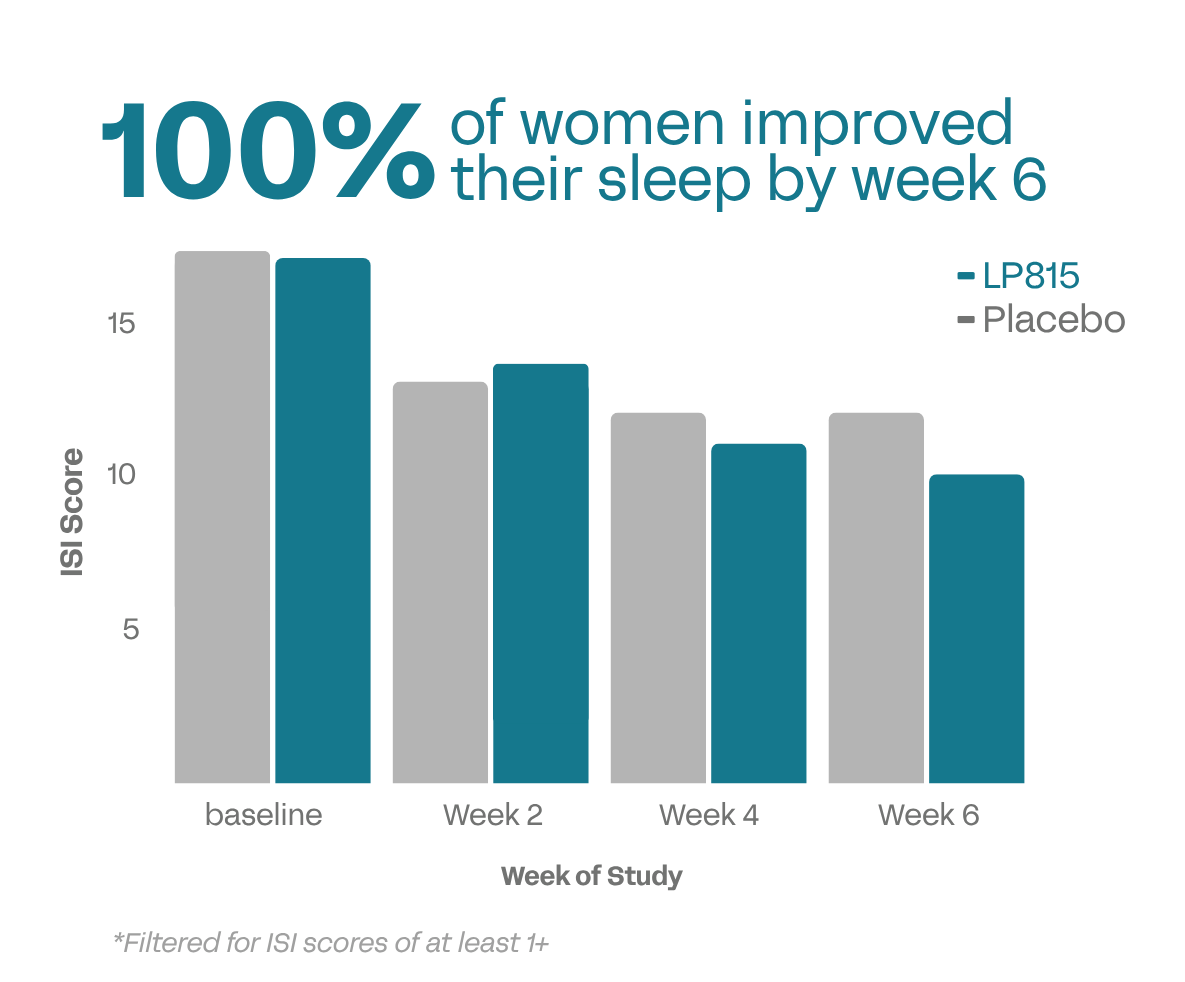
I wasn’t necessarily surprised by the fact that people were sleeping better. I think the literature was pretty clear that if you had elevated GABA, you would probably sleep better. What was of interest to me was that while we saw benefits for both men and women, all of the women who were enrolled in this trial, who were on LP815, showed a benefit.
At first thought, I wondered why women would see a benefit; perhaps because of body size. Women tend to be smaller than men. As we dug into the physiology of what’s happening in women, we saw that GABA plays a more sensitive and almost uniquely important role in women’s health. GABA helps regulate hormones and how they signal in the body, and as women age, their bodies naturally produce less of it. A little bit more GABA being added into the system showed a significant benefit for women. They felt it. We saw it in their metrics. For me, that was exciting, and it was my aha moment.
Which sleep-related endpoints showed the most meaningful improvements, and why are those particularly relevant for today’s consumers?
The first thing that we saw was that there was an increase in GABA production for those who were on LP815. LP815 was shown to be the engine that’s providing the fuel and output to have these improvements in sleep.
From my viewpoint, the meaningful improvement was the increase in deep sleep. Because deep sleep is a time when you are solidifying and strengthening the memories. It’s a time when your immune system is ramping up and becoming healthier, and also this is a time when muscles are being repaired. This is the time of restful sleep.
This is a big benefit and of interest to people, since deep sleep directly impacts health. It’s why you’re sleeping: you’re sleeping to restore and replenish your body. We’re seeing a significant increase in this when you’re taking LP815.
The data showed notable efficacy among women. What insights does that provide for brands targeting women’s health, stress, or sleep categories?
In the clinical, 100% of women taking LP815 experienced better sleep. This was huge. It showcases there’s a notable interrelationship between stress and sleep, especially for women during their life stages.
Do you see LP815 as a standalone hero ingredient for sleep formulations or as part of multi-ingredient formulations, and why?
I do think LP815 is a hero ingredient, but sleep, as I said before, is its own system. Some people have issues with sleep, and it may be falling asleep, or it may be something related to an acute incident.
Others have this chronic impact where they’re not able to stay asleep. Or maybe they’ve had it for a longer period of time, or there’s nothing really in their lives that’s contributing to their decline in sleep. It just is. And so I think this can be positioned differently.
For individuals who want to increase sleep time and quality and have a more holistic approach to sleep. This can be beneficial by itself. It can help people stay asleep. You’ll have more time in bed, more time sleeping, and deeper sleep. But it may not have direct impacts on sleep efficiency right away, and that’s where you can add in other ingredients to a formulation that will help people fall asleep sooner, fall asleep faster, and this will help you really stay asleep.
I don’t think there’s any one particular ingredient that’s going to totally set your sleep right, yet LP815 is another arrow in the quiver, if you will, to allow us to have better sleep hygiene and more consistent sleep over time.
Do you want to highlight any other takeaways from the sleep and stress clinicals?
From both of these trials, what we’ve learned is that as we go through day-to-day life, GABA is being regulated, and it’s not always in a way that’s beneficial for us. We create less GABA when we’re stressed and create less GABA as we age. If we can reinforce and fortify GABA production within our body at safe levels, this can help with the bedrock foundation for better sleep, which drives many of the benefits in our body, from our immune system, to repair, to decreasing anxiety.
There’s an increase in GABA, and people can feel this benefit. There are metrics that we can look at, whether that’s through the Oura ring or through urine samples, to show GABA is up. In the end, you can feel a difference.”
About Noah Zimmerman, Ph.D.
Noah has over 25 years of experience in science and technology, specializing in microbiome health. Prior to Verb, Noah was awarded an Innovation Grant from the U.S. National Institute of Health and helped to co-found Agro BioSciences Inc., where he was the Director of Research. He later led the Biochemistry, Immunology, and Human Probiotics Platforms at Church & Dwight Co. Inc. Noah has a proven track record of probiotic innovation and is actively patenting the use of multiple probiotic strains for various health benefits.
Noah earned his Ph.D. and M.S. from the University of Wisconsin, with an emphasis in Disease Physiology.